Preferential Location Charges (PLC) are an important additional cost to understand when buying a new apartment. Most buyers focus on the basic price, carpet area, location and amenities, but the final cost of a flat can also include charges that are not always easy to understand.
PLC, or Preferential Location Charges, may apply to apartments or units with a more desirable location within a project.
If you are planning to buy a premium flat in Patiala, understanding Preferential Location Charges can help you compare apartments more accurately and avoid surprises in your final cost sheet.
What Are Preferential Location Charges?
Preferential Location Charges are additional charges applied to apartments that have a more desirable position within a residential project.
For example, a flat may have a better view, location, orientation or floor compared with another apartment of similar size.
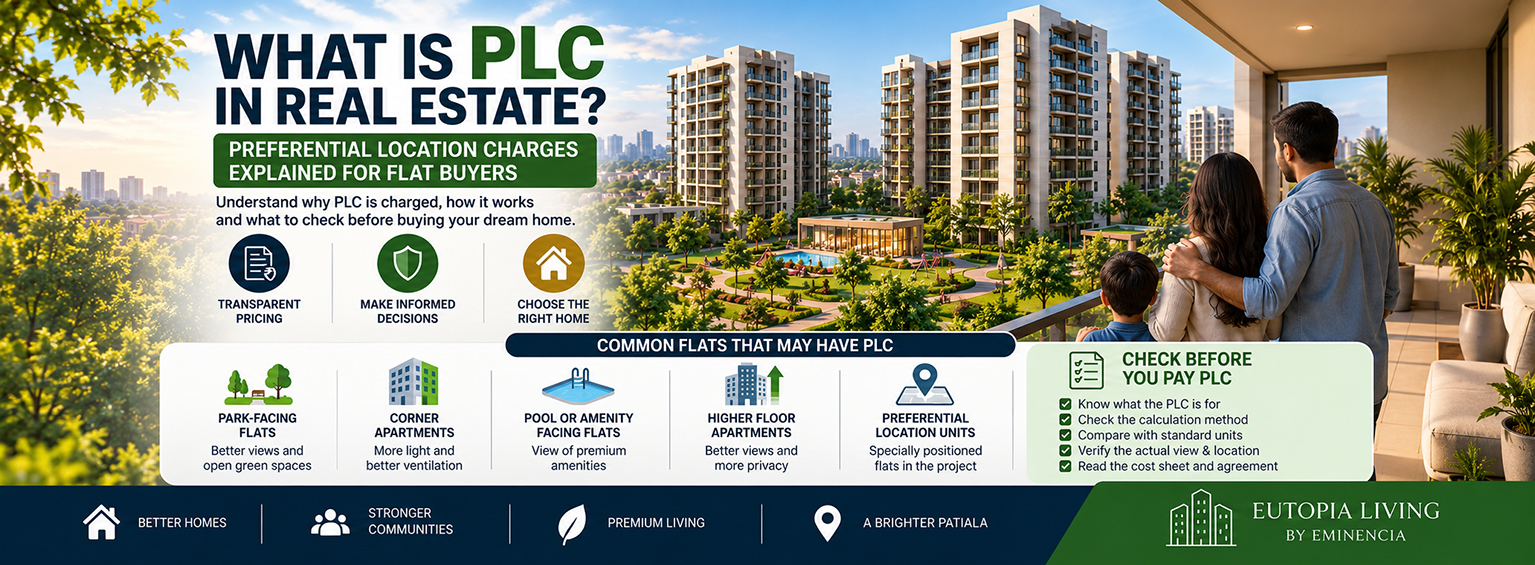
Common examples include:
- Park-facing apartments
- Garden-facing apartments
- Corner apartments
- Pool-facing apartments
- Apartments with better open views
- Certain higher-floor apartments
- Apartments located in particularly preferred positions
The exact PLC structure and amount can vary from one project to another.
Why Do Builders Charge PLC?
Not every apartment within a project offers exactly the same living experience.
Two flats may have the same carpet area but differ in:
- View
- Privacy
- Natural light
- Ventilation
- Noise levels
- Floor position
- Proximity to amenities
- Open-space visibility
Because of these differences, developers may assign an additional premium to certain units.
How Is PLC Calculated?
PLC can be calculated in different ways depending on the project.
For example, a developer may specify:
PLC = Applicable rate × applicable apartment area
In some projects, PLC may instead be expressed as a percentage of the basic sale price.
Therefore, buyers should not assume that every project follows the same calculation method.
Simple Example
Suppose:
- Basic apartment price = ₹80 lakh
- Applicable PLC = 5%
The PLC would be:
₹80 lakh × 5% = ₹4 lakh
The apartment’s cost before other applicable charges would therefore become ₹84 lakh.
This is only an example. Actual PLC rates and calculation methods vary by project.
Which Flats Usually Have PLC?
PLC commonly applies to apartments with features such as:
1. Park-Facing Flats
A flat overlooking a landscaped garden or park may offer a more open view and potentially better privacy.
2. Corner Apartments
Corner units may offer additional exposure to light and ventilation, depending on the building design.
3. Pool or Amenity-Facing Flats
Apartments overlooking a clubhouse, swimming pool or landscaped amenity area may attract a premium.
4. Higher Floors
Some projects apply separate floor-rise or location-related premiums to higher floors. Buyers should check whether this is included under PLC or listed separately.
5. Specially Located Units
Some apartments may have a particularly desirable position because of their orientation, open frontage or distance from common activity areas.
PLC vs Floor Rise Charges
PLC and floor-rise charges are not necessarily the same thing.
PLC generally relates to the location or position of the apartment.
Floor-rise charges generally relate to the floor on which the apartment is located.
For example, a developer could charge PLC for a park-facing apartment and a separate floor-rise charge for a higher floor.
Always ask for these charges separately in the cost sheet.
Is PLC Included in the Advertised Property Price?
Not always.
This is why buyers should look beyond the headline price when comparing flats.
Before booking an apartment, ask for a detailed cost sheet showing:
- Basic sale price
- PLC
- Floor-rise charges
- Parking charges, if applicable
- Club or amenity charges, if applicable
- Maintenance-related charges
- Government taxes and statutory charges
- Registration and stamp-duty costs
- Any other applicable charges
The total purchase cost is more important than the advertised starting price.
Is Paying PLC Worth It?
That depends on what the location offers and what matters to you.
PLC may be worth considering if the apartment provides a meaningful advantage such as:
- Better open views
- More natural light
- Greater privacy
- Better ventilation
- Less disturbance
- Preferred orientation
- A location you personally value
However, a premium location is not automatically worth paying extra for every buyer.
Think about how you will actually use the apartment rather than paying simply because a unit is labelled “premium.”
5 Things to Check Before Paying PLC
1. Ask What the PLC Is For
Do not simply accept “PLC” on the quotation. Ask the developer to specify exactly why the charge applies.
2. Check the Calculation
Confirm whether PLC is calculated per sq. ft., as a percentage, or through another method.
3. Compare Similar Units
Ask for the price difference between a standard unit and the preferential unit.
This helps you understand the actual premium.
4. Verify the Location
If you are paying for a park-facing or open-view apartment, check the actual floor plan and site layout.
The view from the apartment matters more than the label.
5. Read the Agreement
The final buyer documents should clearly explain applicable charges and the conditions associated with them.
Keep a copy of the cost sheet and agreement for your records.
PLC and Premium Apartments in Patiala
As premium residential projects become more lifestyle-focused, buyers are paying greater attention to factors beyond apartment size.
Views, green spaces, amenities, privacy and apartment positioning can all influence the overall appeal of a home.
For buyers exploring premium flats in Patiala, understanding PLC is therefore an important part of comparing different apartment options.
At Eutopia Living by Eminencia, buyers can evaluate apartments based not only on size and configuration but also on the overall community environment, amenities, open spaces and location.
Final Thoughts
Preferential Location Charges are an important part of understanding the actual cost of a premium apartment.
Before choosing a flat, don’t compare apartments only by their basic price. Look at the total cost, location, view, floor, amenities and long-term suitability.
A well-positioned apartment may offer a better living experience, but the premium should always be understood clearly before making a purchase decision.