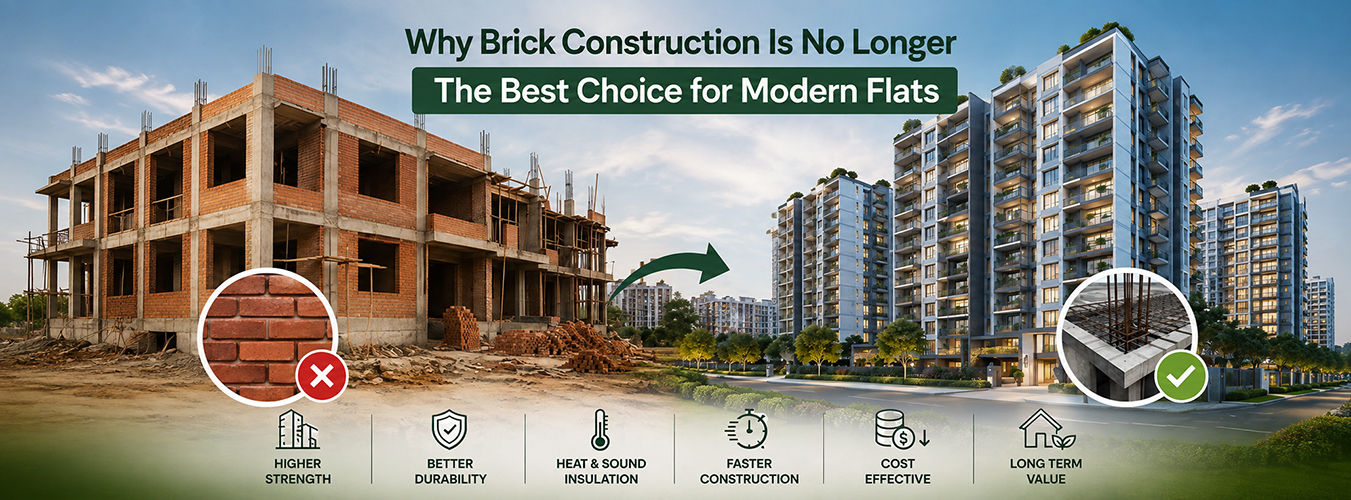
For decades, brick construction has been the traditional choice for homes in India. Many people still associate brick walls with strength and durability. However, when it comes to modern multi-storey apartment projects, construction technology has evolved significantly.
Today, leading residential developers are increasingly adopting RCC frame structures and MIVAN construction technology instead of relying heavily on traditional brick masonry.
So, does that mean brick construction is bad? Not at all. Brick walls still have their uses. But for high-rise and premium apartment projects, they are no longer considered the most efficient or future-ready option.
The Problem with Traditional Brick Construction in Flats
In older apartment buildings, brick walls were often used extensively for both partitioning and supporting structural elements. This approach works for many low-rise buildings, but it has several limitations in modern apartment construction.
Common Challenges
* Heavier overall structure
* More joints and plaster work
* Higher chances of cracks over time
* Slower construction process
* Less flexibility in floor planning
* Increased maintenance requirements
These issues become more noticeable in large residential towers where consistency and structural performance are critical.
Why Modern Flat Buyers Prefer Advanced Construction Technology
When buying a flat, homebuyers usually focus on:
* Structural strength
* Long-term durability
* Better finishing quality
* Low maintenance
* Efficient use of space
* Faster project completion
* Better resale value
Modern construction systems are designed to address these expectations more effectively than traditional brick-heavy construction methods.
Brick Walls Add Significant Weight
One of the biggest disadvantages of extensive brick masonry in apartment projects is dead load (the permanent weight of the building).
More weight means:
* Higher stress on the structure
* Larger foundation requirements
* Increased material consumption
* Reduced construction efficiency
In contrast, RCC and MIVAN-based systems are engineered to distribute loads more efficiently, making them better suited for multi-storey residential developments.
Cracks Are More Common in Brick-Plastered Walls
If you have lived in an older apartment, you may have noticed:
* Hairline cracks near doors and windows
* Plaster cracks at wall joints
* Damp patches around brick joints
These problems often occur because brick masonry and plaster respond differently to temperature changes and structural movement.
With monolithic RCC construction (used in MIVAN systems), there are fewer joints, which helps reduce the likelihood of such surface defects.
Construction Quality Is More Consistent
Traditional brick construction depends heavily on:
* Brick quality
* Mortar mixing
* Mason workmanship
* Plaster finishing
Variations in workmanship can lead to uneven walls, hollow joints, and inconsistent finishing.
Modern formwork systems like MIVAN construction produce:
* Uniform wall thickness
* Smooth wall surfaces
* Better dimensional accuracy
* Consistent construction quality across all floors
This is one reason why many premium residential projects prefer this technology.
Faster Construction Means Better Project Efficiency
Brick masonry is a labour-intensive process. Every wall requires:
1. Brick laying
2. Curing
3. Plastering
4. Additional finishing work
For large apartment projects, this can significantly increase construction time.
MIVAN construction uses aluminium formwork, allowing walls and slabs to be cast together in a systematic cycle. This helps improve construction speed and project efficiency.
Better Space Utilisation
Thicker brick walls can reduce usable carpet area.
Modern RCC wall systems are generally more space-efficient, which means buyers may get:
* Larger usable rooms
* Better furniture placement
* Improved floor plan efficiency
* More practical living space within the same super area
For apartment buyers, usable carpet area is often more important than the advertised super area.
Does This Mean Brick Construction Should Never Be Used?
No. Brick masonry is still suitable for:
* Independent houses
* Low-rise buildings
* Boundary walls
* Partition walls in certain applications
The key point is that extensive traditional brick-based construction is becoming less suitable for modern premium apartment projects, especially high-rise residential towers.
Why Many Premium Apartment Projects Use MIVAN Construction
MIVAN construction offers several advantages that align with modern homebuyer expectations:
Key Benefits:-
* Strong RCC monolithic structure
* Better earthquake performance
* Smooth wall finish
* Reduced plaster work
* Faster project execution
* Improved durability
* Better long-term maintenance performance
This is why it has become a preferred choice for many contemporary residential developments across India.
What Should Flat Buyers Check Instead of Just Asking “Brick or RCC?”
Rather than focusing only on whether bricks are used, ask these more important questions:
Smart Questions for Buyers
* What is the structural system of the building?
* Is it an RCC framed structure?
* What construction technology is being used?
* How is waterproofing handled?
* What is the quality of finishing materials?
* Are the walls load-bearing or non-load-bearing?
* What maintenance advantages does the construction method offer?
These factors provide a much clearer picture of the apartment’s long-term quality.
Final Thoughts
Traditional brick construction has served the Indian housing industry for many years, but modern apartment living demands better structural efficiency, durability, finishing quality, and space utilisation.
For contemporary multi-storey residential projects, advanced systems such as RCC framed structures and MIVAN construction technology generally offer significant advantages over conventional brick-heavy construction methods.
As a homebuyer, don’t judge a flat solely by the presence of brick walls. Evaluate the overall construction technology, structural quality, and long-term maintenance benefits before making your decision.
Frequently Asked Questions
Is brick construction bad for flats?
No. Brick construction is not inherently bad, but modern high-rise apartment projects often use more advanced RCC-based construction systems for better structural performance and efficiency.
⸻
Why do premium apartment projects prefer MIVAN construction?
MIVAN construction provides a strong monolithic RCC structure, uniform finishing, faster construction, and better long-term durability.
⸻
Which is better for high-rise flats: brick construction or RCC/MIVAN?
For multi-storey residential towers, RCC/MIVAN construction is generally considered more suitable due to its structural efficiency, consistency, and maintenance advantages.
⸻
Does MIVAN construction reduce cracks?
Because it uses a monolithic RCC structure with fewer masonry joints, it can help reduce the occurrence of certain types of surface and joint-related cracks compared to traditional brick-plastered wall systems.
View More:-
* 2 BHK Flats in Patiala
* 3 BHK Flats in Patiala
* 3+1 BHK Unit Plan
* Luxury Flats in Patiala
* Apartments in Patiala
* 2 BHK vs 3 BHK