When buying a high-rise apartment, choosing the right floor is an important decision.
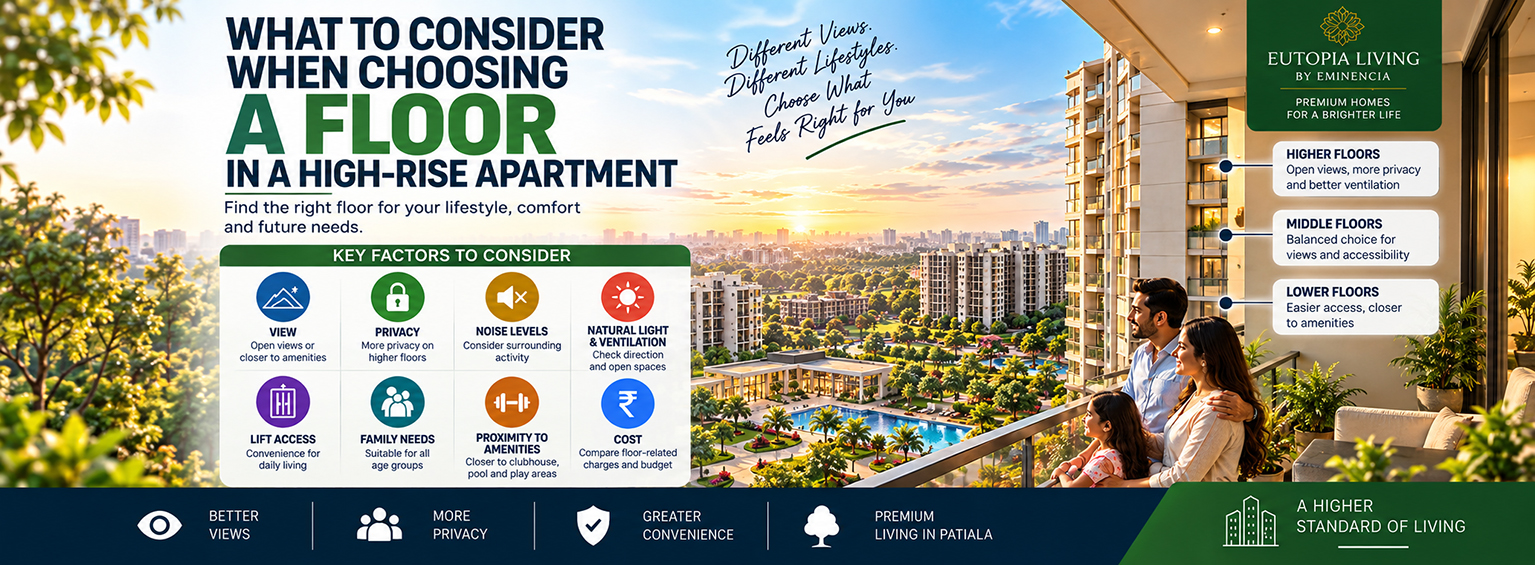
Many buyers immediately assume that a higher floor is always better. Others prefer lower floors because they are easier to access. In reality, the right choice depends on your lifestyle, priorities, family requirements and the specific design of the residential project.
If you are looking at high-rise flats in Patiala, here are the key factors to consider before selecting your floor.
Why Does the Floor Matter?
The floor you choose can influence several aspects of everyday apartment living, including:
- Views
- Privacy
- Noise levels
- Accessibility
- Natural light
- Ventilation
- Lift dependency
- Emergency access
- Family convenience
- Overall apartment experience
The same apartment configuration can feel quite different depending on its floor and exact position within the tower.
1. Consider the View
One of the most obvious differences between floors is the view.
Higher floors may provide a more open perspective, while lower floors may have a closer connection to landscaped areas and community spaces.
Before choosing a floor, look at the project’s master plan and surrounding development.
Ask:
- What will be visible from the balcony?
- Are there other towers nearby?
- Is there an open area in front?
- Could future construction affect the view?
- Which direction does the apartment face?
Don’t judge the view only from a sample image. Visit the actual site whenever possible.
2. Think About Privacy
Privacy can be an important consideration for families.
A higher-floor apartment may feel more separated from ground-level activity, while lower floors can have easier visual access to landscaped areas and common spaces.
Check the distance between towers and the position of neighbouring apartments.
Also consider whether your balcony or windows directly face another residential unit.
3. Check Noise Levels
Different floors can experience different types of noise.
Lower floors may be closer to:
- Entrance areas
- Parking
- Roads
- Clubhouse facilities
- Play areas
- Swimming pools
- Internal movement
Higher floors may reduce some ground-level noise, but other sounds—such as lifts, nearby apartments or outdoor activity—can still be noticeable.
When visiting a property, spend a few minutes listening to the surroundings instead of evaluating the apartment only visually.
4. Natural Light and Ventilation
Floor level can influence how much open exposure an apartment receives, but it is not the only factor.
Also consider:
- Window size
- Apartment orientation
- Balcony position
- Distance between towers
- Nearby buildings
- Surrounding open spaces
A well-positioned apartment on a moderate floor may have excellent daylight, while another apartment higher up may have less favourable orientation.
5. Accessibility Matters
Think about how easily you can enter and leave your apartment.
If your family includes:
- Elderly parents
- Young children
- People with mobility limitations
then convenient access may be particularly important.
Lift availability, staircase access and the distance from your apartment to the lift lobby should all be considered.
6. How Important Is Lift Dependency?
High-rise living naturally involves greater dependence on elevators.
Before choosing an apartment, find out:
- How many lifts serve the tower?
- Where is your apartment located relative to the lift?
- Is there a separate service lift?
- How accessible are the stairs?
- What happens during maintenance or temporary lift downtime?
These details can make a noticeable difference to everyday convenience.
7. Consider Your Family’s Lifestyle
There is no single floor that works for every family.
For example, a family with young children may have different priorities from a couple looking for maximum privacy.
Think about your daily routine.
Ask yourself:
Do I value a higher viewpoint?
Would I prefer quick access to the ground level?
Is proximity to amenities important?
Do I have elderly family members?
How frequently will I use the balcony?
Your answers can help narrow down the most suitable floor.
8. Check the Apartment’s Position Within the Floor
Floor number isn’t the only thing that matters.
Two apartments on the same floor can offer very different experiences depending on their position.
Compare:
- Corner vs central unit
- Lift proximity
- Staircase proximity
- Facing direction
- Balcony orientation
- Distance from neighbouring towers
- Position relative to common facilities
The exact apartment location can sometimes be just as important as the floor number.
9. Consider Proximity to Amenities
If your apartment overlooks or sits close to a clubhouse, swimming pool, children’s play area or sports facility, consider both the convenience and potential activity around that location.
Being close to amenities can be convenient, but buyers should also consider noise, movement and privacy.
Think about what works best for your lifestyle rather than simply choosing the apartment closest to a facility.
10. Think About Emergency Access
Emergency preparedness is an important consideration in any high-rise building.
Before buying, understand:
- Staircase locations
- Emergency exits
- Fire-safety arrangements
- Access routes
- Building safety systems
Ask the developer or relevant project representative about the building’s applicable safety provisions.
Never choose a floor based only on the view or price without understanding the building’s safety arrangements.
11. Consider Future Convenience
You may be comfortable with your preferred floor today, but think about your needs several years from now.
Consider:
- Family changes
- Elderly parents
- Children growing up
- Accessibility
- Daily shopping
- Moving furniture
- Deliveries
- Maintenance visits
A floor that works well for your current lifestyle should ideally remain practical as your needs change.
12. Compare the Total Cost
Different apartments may have different pricing depending on their position, floor, orientation or other applicable charges.
Before booking, ask for a detailed cost sheet.
Check whether the price includes or separately lists:
- Basic apartment price
- Preferential Location Charges
- Floor-rise charges
- Parking
- Maintenance-related charges
- Club or amenity charges
- Applicable taxes
- Other project-specific costs
Don’t choose a floor simply because it sounds premium. Compare the actual additional cost with the features you are receiving.
What Should You Do Before Selecting a Floor?
Before finalising your apartment, try this simple checklist:
☐ Visit the project site
☐ Check the tower and apartment position
☐ Understand the direction and orientation
☐ Look at surrounding buildings
☐ Check the balcony view
☐ Ask about lift arrangements
☐ Understand fire and emergency access
☐ Compare applicable floor-related charges
☐ Consider your family’s future needs
☐ Compare different apartments before booking
Choosing a Floor at Eutopia Living by Eminencia
For buyers exploring Eutopia Living by Eminencia in Patiala, floor selection can be considered together with the project’s tower layout, apartment configuration, open spaces, amenities and surrounding environment.
The project is planned as a high-rise residential development with multiple towers and spacious apartment configurations. Buyers should review the latest floor plans, available units, applicable pricing and project documentation before selecting a specific apartment.
Final Thoughts
Choosing the right floor is not simply about selecting the highest or lowest available option.
It is about finding the apartment position that fits your lifestyle, family requirements, budget and expectations.
Before booking a high-rise flat in Patiala, compare the view, privacy, noise, accessibility, ventilation, lift arrangements, apartment position and total cost.
A little extra research before booking can help you choose an apartment that feels right not only on paper, but also in everyday life.
Frequently Asked Questions
Which floor is best in a high-rise apartment?
There is no single floor that is best for everyone. The right choice depends on your priorities, family needs, budget, views, privacy and accessibility.
Are higher floors always better?
Not necessarily. Higher floors may offer different views and privacy, while lower floors may provide easier access and convenience.
Should families with elderly members consider lower floors?
Accessibility may be an important consideration for families with elderly members. Buyers should evaluate lift availability, staircase access and daily convenience.
Does the floor affect apartment pricing?
It can. Some projects apply floor-rise charges or other premiums. Always ask for a detailed cost sheet.
What should I check besides the floor number?
Check the apartment’s orientation, balcony, view, neighbouring towers, lift location, noise, privacy and proximity to common facilities.
Should I visit the property before choosing a floor?
Yes. A site visit can help you understand the actual surroundings, views, noise and relationship between different towers much better than a brochure alone.